


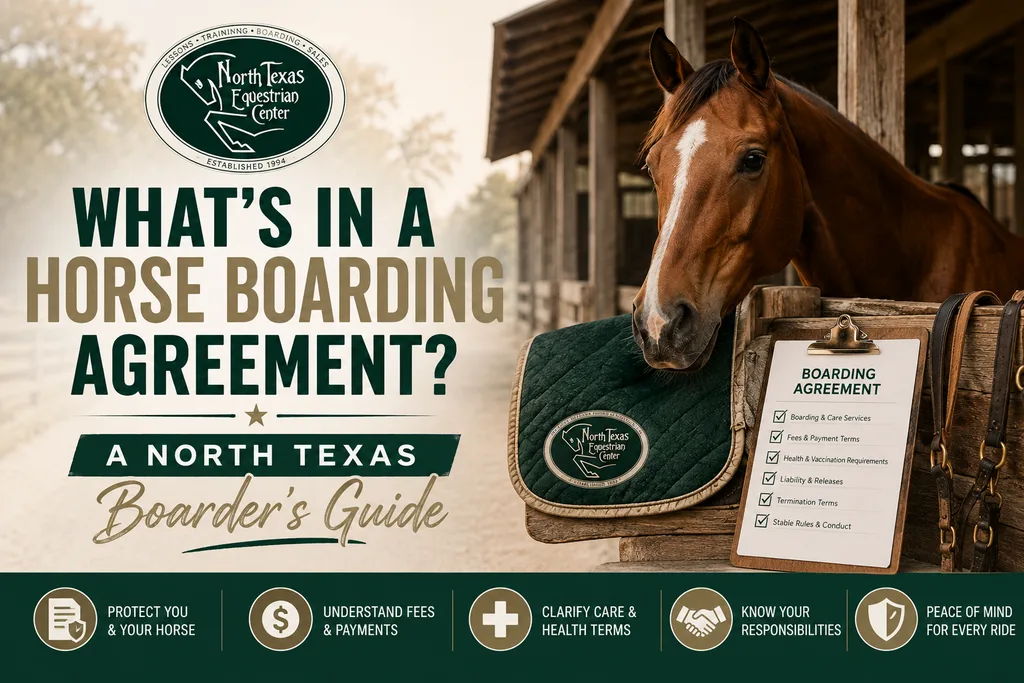
Boarding a horse means trusting a facility with your animal’s daily care, and the boarding agreement is the document that spells out exactly what that trust covers. Yet many first-time boarders sign without fully understanding what a good agreement should include — and what questions to ask before they do. Whether you’re new to boarding or switching facilities, here’s what to look for in a horse boarding agreement and why each piece matters.
Why a Written Boarding Agreement Matters
A verbal understanding might feel fine on day one, but horse boarding involves real money, real liability, and a live animal that depends on consistent care. A written agreement protects both the barn and the owner by setting clear expectations up front, so nobody is guessing later about what was promised. If a facility can’t produce a written agreement, that alone is worth asking about before you commit.
Core Terms Every Boarding Agreement Should Cover
- Monthly rate and what it includes. Does the base rate cover feed, turnout, stall cleaning, and blanketing, or are these billed separately? Ambiguity here is one of the most common sources of billing disputes.
- Payment terms and late fees. When is payment due each month, what happens if it’s late, and what’s the process if payment stops entirely?
- Notice period to leave or be asked to leave. Most facilities require 30 days’ written notice from either side. Know this number before you sign, not after you need it.
- Feed and turnout schedule. A good agreement specifies feeding times, hay type and quantity, and turnout hours — details that matter a lot if your horse has dietary needs or turnout restrictions.
- Veterinary and farrier authorization. Who can call a vet in an emergency if you’re unreachable, and does the facility require your own vet/farrier or work with preferred providers?
- Health and vaccination requirements. Most facilities require current Coggins testing and a specific vaccination schedule before a horse is accepted, both to protect your horse and every other horse on the property.
Liability and Insurance: The Section Owners Skim Past
Nearly every boarding agreement includes a liability waiver or release, and it’s worth actually reading rather than skimming. Horses are inherently unpredictable animals, and Texas law generally limits a facility’s liability for injuries resulting from normal equine activity under the Texas Equine Activity Limitation of Liability Act — but that protection typically depends on proper signage and a properly executed release being in place. Ask directly:
- Does the facility carry liability insurance, and does that coverage extend to boarders on the property?
- Is major medical or mortality insurance on your horse your responsibility, the facility’s, or not addressed at all?
- What happens if your horse injures another horse, a person, or facility property?
A facility’s own release and waiver documents — like our Board Agreement Form — should clearly lay out what’s covered and what isn’t, in plain language you can actually read before you sign.
Texas’s equine liability statute requires specific warning language to be posted at the facility and, in many cases, included in written contracts in order for the liability limitation to apply. If a facility’s agreement doesn’t include this language at all, it’s worth asking why — either the document is outdated or the facility hasn’t had it reviewed recently, neither of which is a great sign.
What Happens If Something Goes Wrong
A well-written agreement anticipates problems instead of leaving them to be sorted out in a stressful moment. Look for language addressing:
- Emergency care and cost approval. Is there a dollar threshold above which the facility must reach you before authorizing veterinary treatment?
- Non-payment consequences. Facilities in Texas may have a legal right (an “agister’s lien”) to retain a horse until unpaid board is settled — understanding this up front avoids a painful surprise later.
- Facility closure or change of ownership. What’s the notice period and transition plan if the facility itself closes or changes hands?
- Rule violations. Clear consequences for things like unauthorized visitors, feeding outside guidelines, or unsafe handling in shared spaces.
Term Length, Renewal, and Rate Increases
Most boarding agreements run month-to-month with an initial minimum term (often 30 to 90 days), auto-renewing unless either party gives notice. A few things worth confirming before you sign:
- How rate increases are communicated. A reasonable agreement specifies advance written notice (typically 30 days) before any rate change takes effect, rather than surprising boarders with a new invoice.
- Seasonal rate differences. Some facilities adjust pricing seasonally for hay costs, blanketing, or extra turnout supervision during extreme weather — this should be spelled out rather than applied ad hoc.
- What triggers automatic renewal vs. a formal re-sign. Knowing whether your agreement quietly rolls forward or requires an active renewal each year avoids confusion about which version of the terms currently applies.
Questions to Ask Before You Sign
- What exactly is included in the monthly rate, and what costs extra?
- How much notice does the facility require, and how much notice will they give me?
- Who has access to my horse, and what’s the visiting policy?
- What’s the plan if my horse needs emergency veterinary care and I can’t be reached immediately?
- Can I bring my own vet and farrier, or is the facility exclusive to certain providers?
- What happens to my deposit if I leave on good terms versus a rule violation?
If a facility’s staff can’t answer these clearly and confidently, that tells you something before you even get to the paperwork. Write down the answers, or ask for them in writing, so you have something to refer back to if a disagreement ever comes up months down the road.
Full Board, Partial Board, and Pasture Board: How Agreements Differ
Not every boarding agreement covers the same level of care, and the terms should reflect exactly which option you’re signing up for:
- Full board. The facility handles feeding, turnout, stall cleaning, and day-to-day care entirely. This is the highest-cost option but requires the least hands-on time from the owner, and the agreement should spell out exactly how many times per day the horse is fed and turned out.
- Partial board. The facility and owner split responsibilities — often the facility handles feeding and turnout while the owner handles grooming and stall cleaning, or some similar split. Because responsibilities are shared, this type of agreement needs to be the most specific about exactly who does what, to avoid gaps where neither party assumes a task got handled.
- Pasture board. Horses live out in a pasture or paddock setting rather than a stall, typically with run-in shelter access rather than a barn. Agreements should specify herd size and turnout group compatibility, supplemental feeding during poor grazing months, and how often the horse is checked.
Make sure the agreement you sign matches the type of board you actually think you’re getting — mismatches between what an owner expects and what a facility intends to provide are one of the most common sources of boarding disputes.
Red Flags to Watch For
Most boarding relationships go smoothly, but a few warning signs are worth taking seriously before you sign anything:
- No written agreement at all, or a facility that seems reluctant to put terms in writing.
- Vague or missing liability language — a facility that hasn’t thought through its own liability protection may not have thought through emergency protocols either.
- No clear emergency contact or veterinary authorization process. If nobody can tell you what happens if your horse colics at 2 a.m. and you’re unreachable, that’s a serious gap.
- Reluctance to let you visit unannounced or tour the facility’s care areas, not just the show-ready spaces.
- No mention of what happens to your deposit or prepaid board if you leave early or the relationship ends on bad terms.
None of these alone is necessarily disqualifying, but they’re worth asking direct follow-up questions about rather than assuming the best. A facility that welcomes tough questions about its agreement is almost always the one that has actually thought its policies through — and that mindset tends to show up in the day-to-day care your horse receives too, not just the paperwork.
Getting Ready to Board
Once the agreement itself is settled, there’s still a practical side to moving a horse to a new facility — health records, what to pack, and what the first weeks typically look like. Our guides on preparing your horse for boarding and a step-by-step boarding checklist cover the logistics side in detail, and our piece on common horse boarding myths addresses a lot of the anxiety first-time boarders feel about handing over daily care.
Boarding at North Texas Equestrian Center
At NTEC, our boarding agreement is straightforward and covers exactly what’s outlined above — rate, care details, health requirements, and liability terms — so there are no surprises once your horse is settled in. Learn more about our boarding program and facilities, review our Board Agreement Form, or contact our team with any questions before you commit to a facility.


